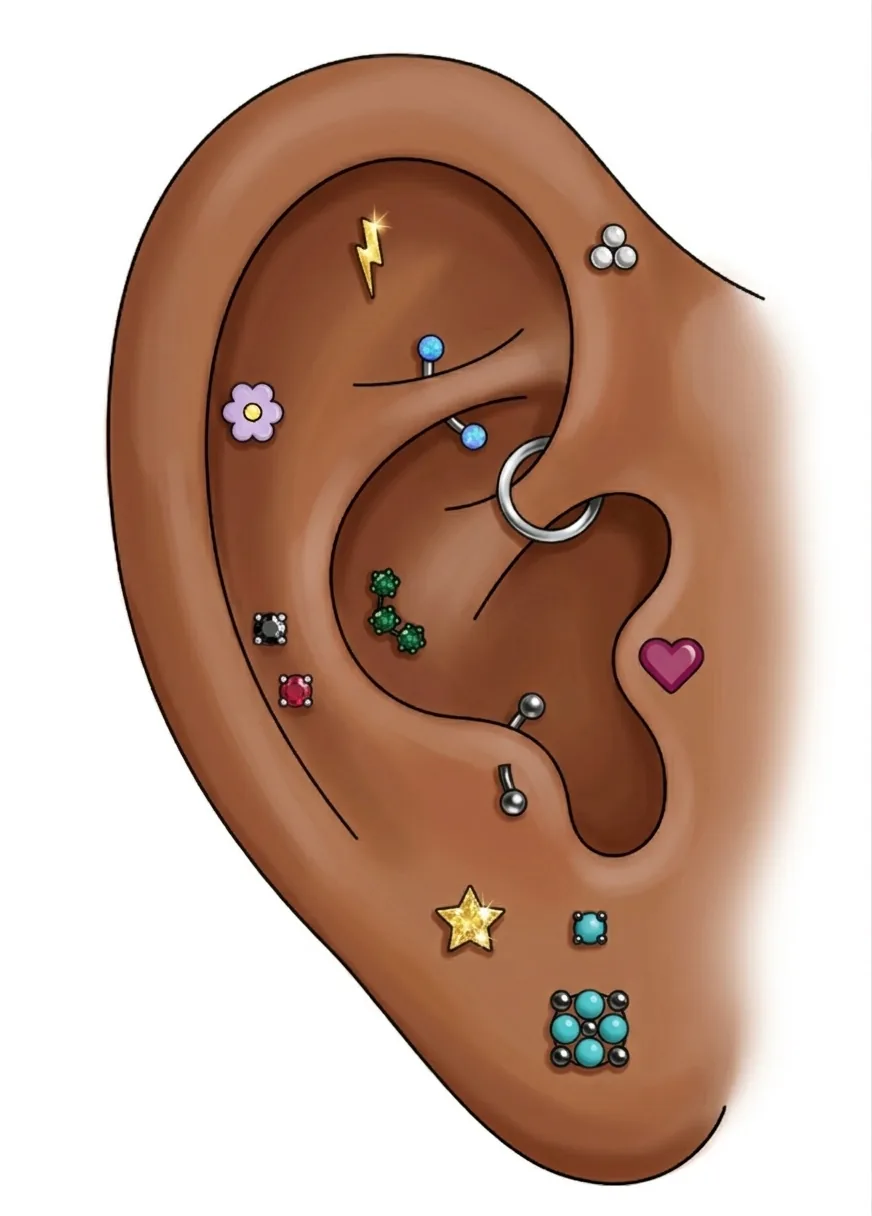
About the rook piercing
The rook goes vertically through the fold of cartilage (the antihelix) above the daith. It needs a well-defined ridge to sit properly, so we always check your anatomy first.
Because the cartilage there is thick, a rook takes longer to heal than most ear piercings. A curved barbell that fits well matters for comfort.
Placement options
What to expect at your appointment
We look at your antihelix ridge, mark the entry and exit points with you, and pierce with a single-use needle. Expect a strong pinch and some throbbing for a day or two.
Every appointment includes a free consultation, and every piercing is done with a sterile, single-use needle. We never use piercing guns, and every tool is autoclave-sterilized and individually pouched.
Healing & aftercare
Spray sterile saline into the ridge, don't play with the barbell, and keep pressure off it while you sleep. Rooks take patience, so plan on most of a year.
Full step-by-step instructions are in our piercing aftercare guide. If anything looks off while it's healing, call or text us. Checkups are free.
Rook piercing FAQ
How much is a rook piercing?
$60, including an implant-grade curved barbell.
How long does a rook take to heal?
Typically 9–12 months. It's one of the slower ear piercings because the cartilage is thick.
Does a rook piercing hurt more than a helix?
Most people find it a bit more intense because the cartilage is thicker, but it's still over in seconds.
Can anyone get a rook?
You need a pronounced enough ridge. Your piercer will check during your free consultation.
Ready for your rook piercing?
Book online in about a minute, or just walk in. We're in Mission Square on Shannon Pkwy, open 7 days.